1980s Gated Reverb, why it Matters?
That iconic 1980s drum sound, from Phil Collins to the best of hair metal, boiled down to a couple of things.
- Compression
- Big Room Reverb
- Gate to Cut the Reverb Tail
While you can achieve similar results in other DAWs or with other plugins, today I want to show you how I get this effect in Reaper using only free plugins (and the reasonably prices Vice Alternative Linndrum samples).
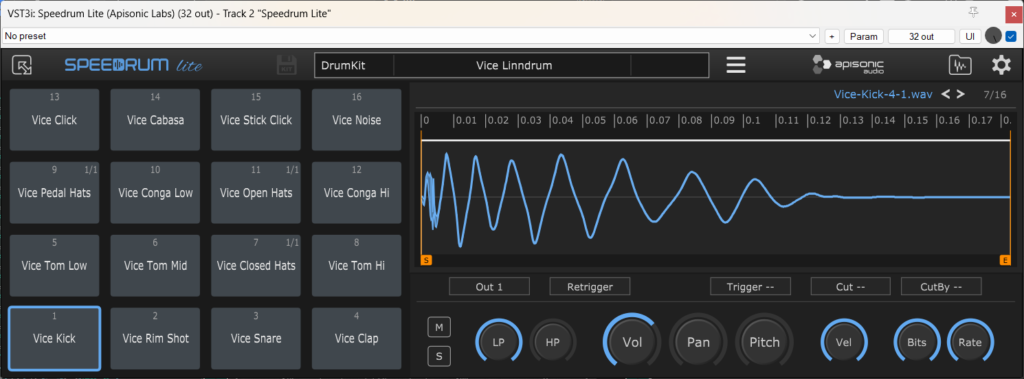
For our drum sampler, we’ll be using Speedrum Lite. I do own Battery 4 which is much more powerful, but it is also aging (and not in a good way). Speedrum Lite is a great free drum sampler with multi-channel output, provided 16 pads are going to be enough for you.
Step 1: Compression
The 1176 or a quality clone is perfect for smashing the snare and toms before they hit the gated reverb. This allows the transient of the dry signal to hit hard and by adding predelay to the reverb we’ll get the full force of that transient before any reverb comes in.
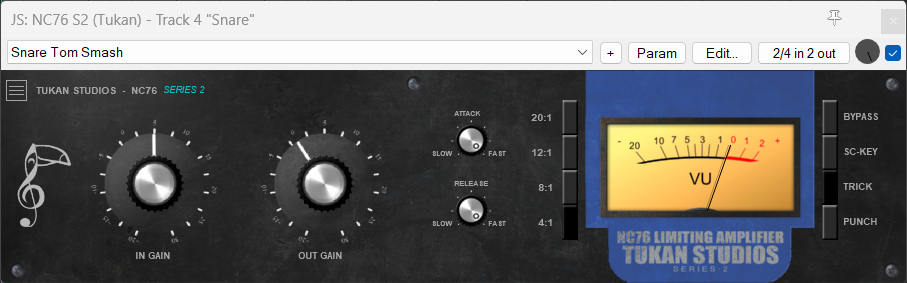
I’m using the Tukan NC76 S2 compressor which is modeled after the 1176 hardware compressor. Here I boost the input gain to about +5db and leave the output gain at 0db. Then I set both attack and release to “fast” before punching the “trick” button. This button gives you the famous all-in (all the ratio buttons pressed) mode on the 1176. We will use the same settings on both the snare and the toms track.
The Aux Track
The next thing to do is to set up an Aux Track to receive the dry signal from the snare and toms tracks. This way we get the full hit and punch of the hard compressed tracks and the gated reverb separately. Many Reaper tutorials will instruct you to sidechain the snare to the gated reverb aux track… don’t do this.
First, we add the Tukan Lexikan 2 reverb plugin that models the famous Lexicon reverb units from the 1980s.
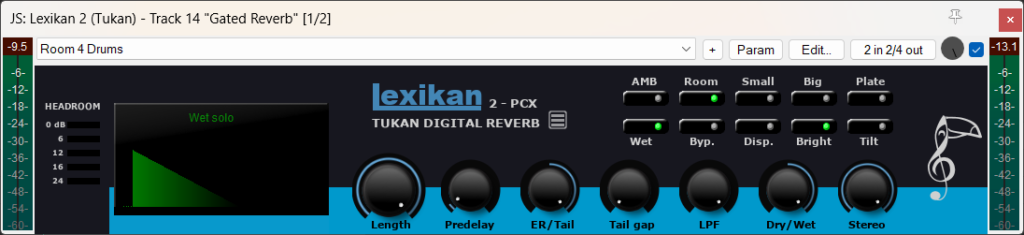
I started with the Room 4 Drums preset and made sure the length was all the way up. Then I added just a bit of predelay. If you add too much, it will bring the reverb in late and sound weird. If you don’t add any, then the reverb will weaken the initial punch of the snare and toms.
I dial up the Dry/Wet to 100% wet. Then I make sure Room, Wet, and Bright are the only buttons selected. The only thing left is the gate.
Gate Your Reverb
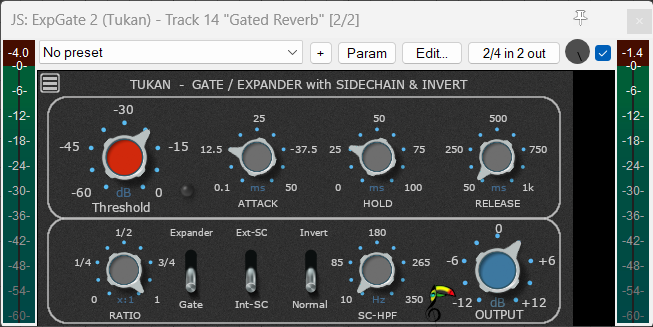
The final step is to add a gate. Here I use the Tukan ExpGate 2 with the following settings:
- Threshold -20db
- Attack 12.5
- Hold 25
- Release all the way to the left (as fast as possible)
- Ratio all the way up
- About +3db
Routing and Fine Tuning
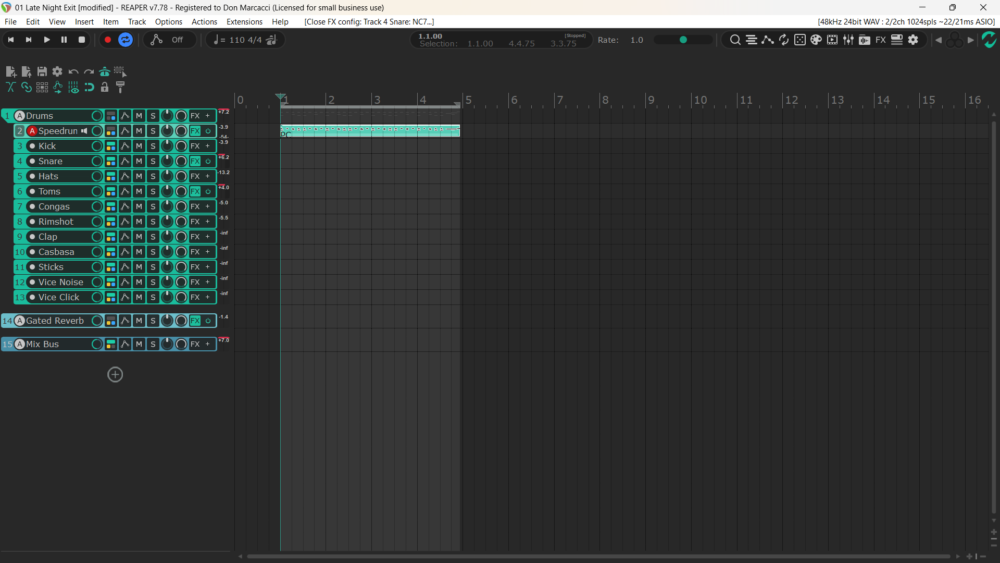
The drums all go into the Drum Bus which doesn’t have a Master Send. Instead, it is routed to the Mix Bus. I do this so that I can control exactly how the mix hits the Master and I never touch the Master directly. In this project, only the Mix Bus has a Master Send. Yes, I know some things are clipping and I need to deal with them😁.
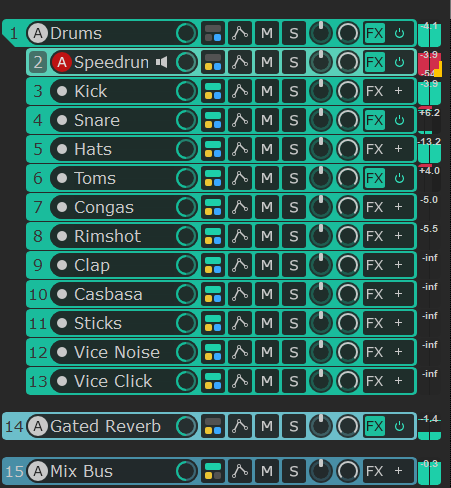
The snare is sent to the Gated Reverb bus at 0db. The toms are sent to the same Gated Reverb bus at about -6db to -7db. Nothing else is sent to our Gated Reverb bus.
The Gated Reverb is an FX Bus and so it doesn’t go through any other bussing. Rather, it goes directly to the Mix Bus.
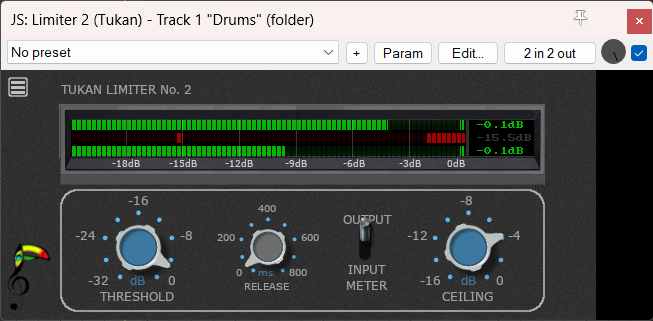
The final step to ensure we have loud drums without clipping the Mix Bus is to use a limiter on the Drum Bus. In this case, I opted for the Tukan Limiter 2. Just play with the Threshold, Release, and Ceiling until you get some gentle compression that doesn’t overload your Mix Bus.
Final Thoughts
When people say you can’t do Synthwave or other 80s style music in Reaper, it’s simply not true. Sure, Reaper has a bit more of a learning curve than other DAWs, but when combined with plugins like the amazing Tukan suite, Reaper is a formidable contender for Synthwave and 80s music in general.
Give it a try! What do you have to loose?
-

-
Phil Collins Style Gated Reverb in Reaper (FREE!)
1980s Gated Reverb, why it Matters? That iconic 1980s drum sound, from Phil Collins to…
